
Inventory, logistics & chain of custody
Secure IT Asset Management
Manage retired IT assets through a controlled identification, collection and movement process that maintains visibility, accountability and audit-ready documentation from pickup to final disposition. Know where your assets are, who handled them, and how they moved through every stage.
Why Inventory & Logistics Control Matters
When IT assets leave production, the biggest risk is not the final treatment—it's the period between decommissioning and final disposition. Devices are moved, packed, handed over, transported, received and processed. Every one of those steps can create loss, confusion or exposure if the workflow is not tightly controlled.
Key drivers :
-
Know what's in scope
clear baseline before downstream actions
-
Track every movement
visibility from pickup through receipt
-
Reduce loss & ambiguity
reconciliation catches discrepancies early
-
Strengthen accountability
documented custody at every handover
-
Support compliance
audit-ready records for governance review
Inventory & Logistics: The Foundation of ITAD
Inventory and logistics are UPSTREAM SERVICES.
They happen before destruction, wiping, remarketing or recycling, and they set the control framework for everything that comes after.
Why this matters:
-
Without clear inventory, downstream actions lack a reliable baseline
-
Without documented custody, subsequent treatments are harder to defend
-
Without reconciliation, discrepancies remain hidden until too late
-
Without visibility, governance and compliance become weaker
Our Inventory & Logistics Approach: Four Pillars
-
1
Asset Identification & Inventory Capture
Assets are identified, listed and grouped before collection so the project starts with a clear scope and controlled baseline. Serial numbers, asset tags, barcodes or internal identifiers are captured to strengthen traceability and reduce mismatch risk.
-
2
Secure Pickup & Controlled Handling
Collection is carried out through a controlled process designed to reduce uncontrolled access, maintain accountability and protect equipment integrity from the first handling step. Equipment is packed and prepared for transport using agreed security procedures.
-
3
Documented Custody & Secure Transport
As assets move through the logistics chain, each custody transfer is logged with timestamps, handover details and transport information. This creates a verifiable record of possession and movement at every stage.
-
4
Receipt, Reconciliation & Exception Handling
Once assets reach their destination, received inventory is reconciled against original pickup records. Any mismatch, exception or condition issue is documented and escalated appropriately before downstream routing.
Our Inventory & Logistics Process
-
Scope Definition & Inventory Preparation
Each project starts by defining equipment scope, pickup locations, handling requirements and reporting expectations. An initial inventory list is prepared before collection begins.
-
Asset Identification & Tagging
Assets are identified using serial numbers, asset tags, barcodes or internal references. Each asset is matched to the project inventory for tracking.
-
Secure Collection & Packing
Equipment is collected through a controlled workflow and prepared for transport using agreed handling and security procedures.
-
Documented Transport & Custody Handovers
As assets move through the logistics chain, each custody transfer is logged with timestamps, handover details and transport information. Every movement is recorded.
-
Receipt, Audit & Reconciliation
Received inventory is reconciled against original pickup records. Any mismatch, exception or condition issue is documented and escalated appropriately.
-
Final Routing & Disposition Planning
Assets move into the relevant downstream workflow: wiping, destruction, remarketing or recycling. Clean inventory data enables better downstream decision-making.
Simple summary:
Inventory → Secure Pickup → Documented Transport → Receipt & Reconciliation → Final Routing
What Chain of Custody Means in Practice
Chain of custody means knowing what each asset is, where it is, who handled it, and what happened to it at every important stage.
In ITAD terms, this includes:
-
Asset identification and baseline inventory
-
Pickup and initial custody handover
-
Transport and intermediate transfers
-
Receipt and reconciliation
-
Final disposition proof
This is what turns a simple logistics action into a controlled process that governance and audit teams can review and defend.
Your Inventory & Logistics Documentation Package
-
Asset lists & inventory records
(complete, itemised)
-
Serial reconciliation outputs
(matches and exceptions)
-
Chain-of-custody forms
(logs, handover signatures)
-
Pickup & receipt documentation
(timestamps, locations, quantities)
-
Exception reporting
(discrepancies, condition issues, escalations)
-
Project-level reporting
(summary for governance and downstream ITAD routing)
Real Scenarios: Who Uses Inventory & Logistics?
Equipment stays at your premises throughout. No transport before data treatment.
-
Office Clear-Outs & Workplace Refresh
Large-scale collection from multiple departments
-
Data Centre Decommissioning
Infrastructure removals involving hundreds of assets
-
Multi-Site Collections
Organisations requiring consistent management across locations
-
Inventory Verification Projects
Internal accuracy verified before downstream treatment
-
Compliance-Heavy Environments
Financial services, healthcare, government sectors
-
High-Volume Asset Recovery
Projects where loss prevention is critical
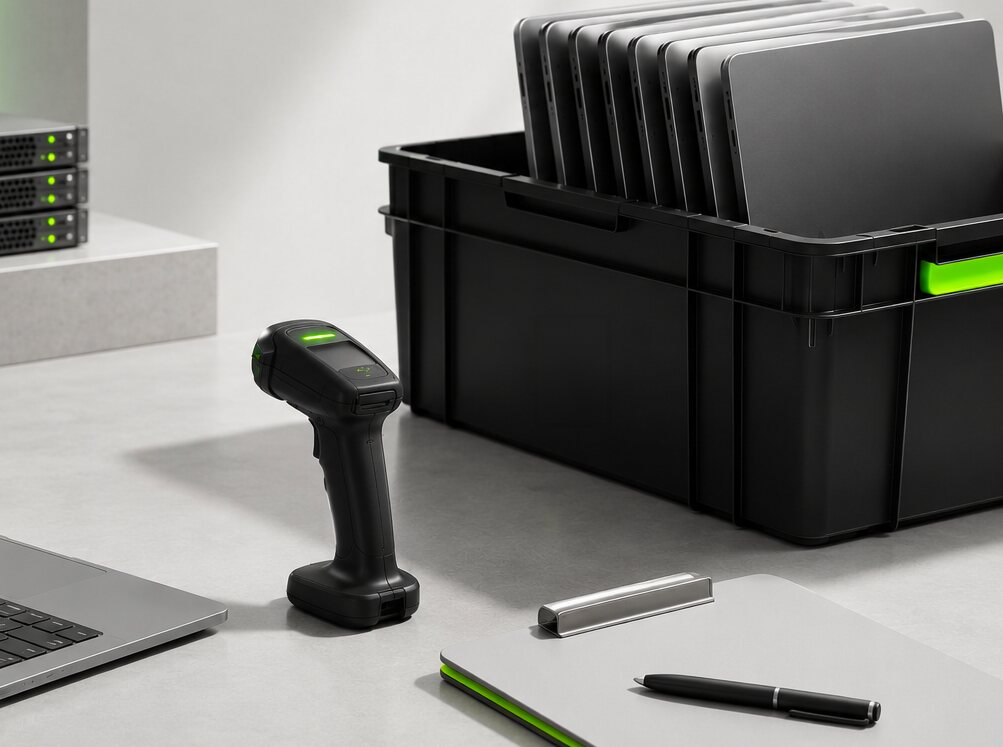
How serial matching works:
- Asset tags, serial numbers or barcodes are captured at pickup
- These are matched against internal asset management records
- Discrepancies are identified immediately
- Exceptions are documented and flagged for resolution
Serial reconciliation provides the baseline required for a defensible chain of custody.
Serial Reconciliation: Turning Assumptions Into Facts
Many organisations think they know what assets they're retiring. In reality, asset lists are often incomplete or inaccurate.
Serial reconciliation changes this.
Common Questions About Inventory & Logistics
-
Asset identification, secure pickup, transport coordination, custody documentation, inventory reconciliation and reporting that supports the wider ITAD process.
-
It creates a documented, verifiable history of each asset from pickup to final disposition, strengthening data security, compliance and accountability.
-
Yes. Serial numbers, asset tags or barcodes captured at pickup are matched against your inventory on receipt, and every mismatch is reported.
-
Inventory and logistics generally happen upstream and create the control framework supporting later actions such as data erasure, destruction, remarketing or recycling.
-
Each discrepancy is documented as an exception, flagged for resolution and escalated according to the agreed procedure before any downstream routing.
-
Yes. We coordinate collections across several locations in Switzerland and Europe with the same standards, tracking and documentation on every site.
-
Asset records, transfer logs, reconciliation outputs, exception reports and project-level documentation supporting internal governance and audit requirements.
Control, Compliance & Governance Case
-
Know Your Assets
Clear inventory baseline reduces assumptions
-
Prevent Loss
Early reconciliation catches discrepancies before assets disappear
-
Strengthen Accountability
Documented custody at every stage supports compliance
-
Reduce Risk
Controlled handling and secure transport minimize loss
-
Enable Better Routing
Clean inventory helps determine best path for each asset
-
Support Governance
Audit-ready records demonstrate diligent asset management
Ready to Take Control of Your IT Asset Inventory?
Discuss your collection requirements, tracking expectations and reporting needs with Katana Digital. We'll design a workflow that keeps assets visible, controlled and audit-ready from pickup through final disposition.